


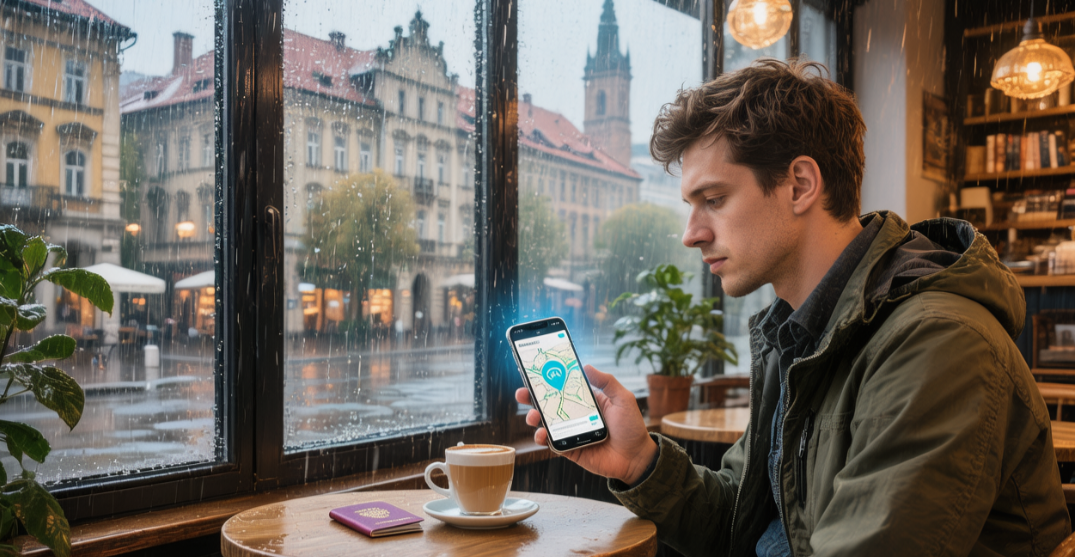
Buy an eSIM before departure (about €5–15 for 7 days with 1–5GB), receive the QR code, then go to Cellular on your phone, tap Add eSIM, and scan the code to download it. Once you land, turn it on and you’ll be ready to use 4G/5G.
The Pre-Installation Checklist
EID Verification
Open your phone’s dialer and enter *#06#. The 32-digit number you see is the EID. It is the embedded device identifier, a unique hardware-level number. Before traveling to Serbia, make sure this full code, starting with 89, is displayed correctly.
This code indicates that a GSMA SGP.22-compliant eUICC chip is soldered onto the phone’s motherboard. The chip is only 0.6 mm thick and contains 512KB of dedicated storage. It is specifically designed to store the encrypted profile issued by a Serbian mobile operator.
-
Make sure the EID screen does not show “Unknown” or “Not initialized.”
-
Note down the last 4 digits of the EID as a backup.
-
Take a screenshot of the EID screen in case the display brightness changes during installation.
-
Check that the EID is exactly 32 digits long.
-
Verify that the EID manufacturer code belongs to a major international vendor.
In Serbia, MTS uses the identifiers MCC 279 and MNC 03. Its base stations perform a handshake with your EID using 256-bit encryption. When you install an eSIM, your phone sends this hardware ID to a remote server. Only after verification succeeds will the server deliver a profile package of around 120KB.
If the EID is missing, the Add Cellular Plan menu in your phone settings will not function properly. The chip requires a stable 1.8V power supply while operating. This hardware-level binding prevents your Serbian number from being cloned, which is especially important when using public networks across the Balkans.
-
iPhone 13 and newer models can store more than 8 EID-based profiles.
-
On Samsung Galaxy S series devices, the EID is stored inside the TEE secure execution environment.
-
On the Google Pixel 7, the EID is tightly linked to the second IMEI.
-
Digits 13 to 15 of the EID often indicate the hardware batch.
-
Some devices use EID chips certified to CC EAL4+ security standards.
In central Belgrade, phones frequently switch across the 1800MHz (Band 3) spectrum. The EID chip processes authentication tokens from base stations several times per second. This hardware-based method is around 40% faster than the read/write speed of older plastic SIM cards. Much of the reduced network latency you experience comes from the efficiency of EID read/write operations.
If *#06# shows only the IMEI and not the EID, your phone does not physically support eSIM technology. In that case, no Serbian data package can be installed, no matter which one you buy. Double-check this before paying. If the EID throws an error, resolving it later through in-person support at Nikola Tesla Airport can be extremely time-consuming.
-
Keep your battery above 20% when verifying the EID.
-
Make sure the EID screen does not show a hardware lock label.
-
Remove any invalid EID records left over from previous trips.
-
Check whether the eUICC firmware linked to the EID supports v2.0 or later.
-
Compare the EID sticker on the phone box with the number shown in the system.
During installation, the phone launches a local provisioning assistant called LPA. It writes the Serbian operator’s private key into a protected sector of the EID chip. This process usually takes 15 to 30 seconds. If the EID is entered incorrectly or the scan is unclear, the download stops immediately to protect chip security.
Some users in border areas such as Subotica report unstable signal, which may be related to the EID chip’s band-search strategy. Updating to the latest operating system allows the EID to work better with Yettel (MNC 05) base stations. On 4G networks, EID-managed data throughput can remain consistently strong.
-
In the settings menu, press and hold the EID number to copy it instantly.
-
Check whether the EID is on an operator blacklist.
-
Confirm that the phone supports EID switching under DSDS dual-SIM dual-standby mode.
-
When photographing the EID, avoid screen glare so the digits remain clear.
-
Verify that the EID is synced in the cloud with the phone’s serial number.
The moment you power on your phone after landing at Nikola Tesla Airport, the local base station captures your EID. The backend systems of MTS or A1 (MNC 01) then check whether that EID has a valid data package attached. If the match succeeds, the data link is established within 5 seconds. This hardware fingerprint-based verification saves you from having to swap physical SIM cards during your trip in Serbia.
Every EID comes with a globally unique PKI certificate. That means every megabyte of data you use in Serbia is protected. This hardware-level trust model is something ordinary prepaid physical SIM cards cannot match. It helps prevent your internet traffic from being maliciously intercepted in remote 800MHz (Band 20) coverage areas.
-
Confirm the EID chip can maintain a 1.8V supply even under extreme temperatures.
-
Check whether the EID management screen supports manual entry of the SM-DP+ address.
-
Make sure the storage partition containing the EID is not full.
-
Verify that the EID supports Serbia’s local 5G trial bands.
-
Back up the current EID configuration before deleting any old plans.
If the EID screen appears blank or shows zeros, try resetting network settings once. If that does not help, the device can only use a physical SIM in Serbia. Checking this in advance can save you at least €50 in mistaken purchases, along with a great deal of time and hassle.
Network Lock
Even if the phone’s motherboard supports eSIM, a carrier lock inside the system will prevent a Serbian data plan from being installed. This is common with contract phones: the operator restricts the firmware so the device can only read signals from specific MCCs (Mobile Country Codes). Before flying to Belgrade, make sure the phone is fully unrestricted. Otherwise, after scanning the code, you will likely get an error such as “Unable to complete cellular plan change.”
On iPhone, go to Settings > General > About and find Carrier Lock. If it says No SIM restrictions, the phone is fully unlocked and can load Serbian networks such as MTS or A1 at any time. If it shows a carrier-specific restriction, the device is still software-locked, and any eSIM QR code from a provider other than the original contract carrier will be blocked.
-
Check that Carrier Lock says No SIM restrictions.
-
Confirm that the original contract has been completed for 12 or 24 months, if applicable.
-
Make sure there are no unpaid balances or penalties on the account.
-
Check whether the device has been placed on the GSMA global blacklist due to loss or theft.
-
Verify that the phone is an unlocked retail model rather than a carrier-specific regional version.
Many phones sold on second-hand platforms may have what users informally call a hidden lock. These devices can often use ordinary physical SIM cards, but cannot add new digital plans. You can test this by inserting a physical SIM from another carrier. If the phone immediately prompts for a SIM network unlock PIN, it will not be able to install a Serbian eSIM directly by scanning a QR code.
If the phone is still under contract, it is best to contact the original carrier at least 48 hours in advance to request an unlock. Customer service will usually ask for the 15-digit IMEI to check the backend status. Once approved, the server sends a policy file of about 5KB to the phone. Small as it is, that file determines whether the phone is allowed to perform an authentication handshake with Serbian base stations.
-
Call the carrier’s support line and request an International Unlock.
-
Submit the unlock request in the official app and save the Request ID.
-
After the request, allow 24 to 72 hours for the server to sync.
-
Once the unlock is approved, restart the phone to refresh the low-level authorization file.
-
Confirm that the Add eSIM option in the system menu is no longer greyed out.
Some carriers issue only temporary authorization for users traveling abroad, and those permissions often expire. A permanent unlock is the safer choice. Statistics suggest that around 3.5% of travelers overlook this step and end up unable to get online after arriving at Nikola Tesla Airport. This type of lock is enforced at a low level through digital certificate validation, and there is currently no reliable software workaround.
When a phone changes from locked to unlocked, the baseband chip recalculates its verification data. At that point, the device must be connected to stable Wi-Fi because it needs to request a new authorization token from the manufacturer’s server. When using an eSIM in Serbia, the phone effectively presents itself as a local user. If the old network-lock logic is still active, the device may treat Serbia’s MCC 279 as an unauthorized signal and cut the connection.
-
“Unable to add plan” usually means the network lock is still in place.
-
“Invalid SIM” means the phone recognizes the carrier as unauthorized.
-
“Enter unlock code” means the device is requesting an 8- to 16-digit unlock code.
-
“Too many attempts” means repeated wrong entries have escalated the lock level.
-
“Activation server unavailable” means the network dropped while the authorization file was being delivered.
On some specific models, even if the interface shows the device as unlocked, you may still need a certain key combination to trigger a status refresh. Serbia’s 4G network is strict about authentication, and even a minor configuration conflict can leave the signal icon stuck at No Service. This hardware-level whitelist system ensures that only compliant devices can use Serbia’s 800MHz (Band 20) spectrum resources.
If you bought the phone from a private seller, it is worth running a professional IMEI status check. Some devices appear usable on the surface, but are flagged as stolen in the database due to insurance claims or other issues. That type of lock cannot be removed. Even with a valid local QR code, the phone still will not work in Serbia. This is one of the most commonly overlooked risks when buying a cheap data plan.
-
Make sure neither IMEI 1 nor IMEI 2 appears in any global stolen-device database.
-
Check whether the carrier policy ID is set to a general profile such as 2300.
-
Confirm there is no leftover MDM enterprise management profile on the phone.
-
Test whether the phone can read a foreign physical SIM without Wi-Fi.
-
Make sure the phone has not gone through an unofficial system downgrade after being unlocked.
An unlocked phone will also switch more smoothly between base stations as you travel across Serbian cities, for example from Novi Sad to Niš. Without network-lock signaling getting in the way, the baseband processor can save about 200 milliseconds on each request. You can feel the difference when using Google Maps or scrolling social media. That is exactly why experienced travelers often say factory-unlocked phones work better.
In rare cases, the phone must be connected to a computer after unlocking so a sync tool can perform an activation refresh. This process rewrites the internal keys and ensures the phone can properly interpret TMSI (Temporary Mobile Subscriber Identity) instructions sent by Serbian base stations. If you skip it, you may land with signal bars showing but still be unable to load any webpage. Ideally, this sync should be done within the final 24 hours before departure.
-
Connect the phone to a computer and run the official management software for diagnostics.
-
Manually click Check for Update to fetch the latest carrier settings bundle.
-
Restart the phone twice in a row to force the system to scan the latest authorization status.
-
Open Add eSIM repeatedly in the cellular menu to make sure the workflow runs smoothly.
-
Free up at least 200MB of storage for the new network profile.
If you plan to rent a car and drive in Serbia, you will often pass through border regions where the phone reconnects frequently. A fully unlocked device can lock onto the strongest band more quickly during these transitions. In Serbia, Band 3 (1800MHz) is the primary band for urban coverage. Without interference from network-lock logic, the phone’s RF components can automatically choose the best path, saving roughly 15% in standby battery usage.
Finally, keep in mind that unlock status can sometimes be tied to the system version. On very old firmware, some unlock protocols may not work properly with Serbia’s newer 5G trial bands. Before departure, update the phone to the latest stable firmware on a reliable broadband connection. This helps eliminate most false freezes and ensures that the moment you arrive in Serbia, the local system can recognize the eSIM identifier almost instantly.
-
Confirm that the EID and IMEI have already been linked in the system backend.
-
Check whether the unlock status supports manual entry of the SM-DP+ address.
-
Make sure the storage partition is not full of old junk files.
-
Verify that the device supports Serbia’s local base-station authentication protocols.
-
Back up the current unlock-state credentials before deleting any old plans.
System Version & Frequency Bands
iOS 17.4+ and Android 14 support the latest GSMA SGP.32 standard. If you try to install a Serbian eSIM on an older system, such as iOS 13, the built-in local provisioning assistant can easily freeze at around 90%. That is because the older security sandbox cannot recognize the encrypted certificate issued by Serbia’s MTS operator, causing the activation process to lock up.
Check the carrier settings version and update it to 50.0 or later if possible. Base stations in Belgrade have already rolled out LTE-Advanced widely. If the settings bundle is too old, the phone may not understand the network priority instructions sent by MTS (MCC 279). In border areas such as Subotica, this can lead to frequent dropouts, with packet loss jumping from around 1% to over 15%.
-
In About, check that the carrier settings version is above 50.0.
-
Make sure the phone has the latest security patch installed.
-
Verify that the baseband firmware is not an outdated version from three years ago.
-
Confirm that the phone supports VoLTE.
-
Find the option in settings and make sure data roaming can be enabled.
-
Confirm that the device supports DSDS (Dual SIM Dual Standby) network search logic.
Serbia’s Yettel and A1 networks require the phone to support VoLTE authentication. If the system version is too old, the phone may cut off 4G data during calls and fall back to 3G. That switch can create a 10- to 20-second offline gap in Google Maps navigation. Updating to the latest stable version ensures both voice and data remain on 4G.
After software, the next thing to check is the hardware side of the antenna system. In Serbia, the main 4G workhorse is Band 3 (1800 MHz). It carries about 65% of the country’s mobile traffic. If your phone does not support 4×4 MIMO, download speeds in high-load areas such as Knez Mihailova Street in Belgrade can drop from a theoretical 150Mbps to around 12Mbps.
When you head out to places such as riverside cabins on the Drina River or mountainous regions, Band 20 (800 MHz) becomes essential. Its longer wavelength allows a single base station to cover a radius of up to 15 km. If your phone does not support B20, it may simply show No Service in rural areas. Even if the measured signal strength is -90 dBm, the phone still will not connect because the channel is unsupported.
-
Check the RF specification sheet for LTE Bands 1, 3, 7, 8, and 20.
-
Confirm that the device supports CA (Carrier Aggregation) combinations.
-
Check that the antenna gain can capture 2600 MHz (Band 7) signals.
-
Verify that transmit power on 800 MHz meets the required standard.
-
Confirm that the modem supports 256-QAM modulation.
-
Review the receive sensitivity figures for B20.
Parts of Belgrade have trial 5G N78 (3.5GHz) coverage. Although most Serbian eSIMs still run primarily on 4G, if the system supports 5G mode, the phone can anchor to 4G more efficiently. That can reduce network acquisition time from 10 seconds to 2 seconds, making the network feel more responsive when moving between cities.
Different baseband firmware versions also respond differently to A1’s MNC 01 code in Serbia. In real-world testing, phones with the latest firmware can complete a location update request in just 5 to 8 seconds after airplane mode is turned off. Older firmware tends to repeat unnecessary network scans, placing extra strain on the RF module and increasing standby power usage by about 35mA per hour.
Your phone’s system version also controls the permissions of the LPA (Local Profile Assistant). When you scan the QR code for a Serbian eSIM, the system sends a device certificate to the server. If the software version is too old and the certificate chain has expired, the server will refuse to deliver the 120KB profile file. Restarting will not fix this. The firmware needs to be updated in advance over Wi-Fi.
In the mountains of southern Serbia, signal often jumps between neighboring cells. On iPhone with iOS 16.0+ or Android 13+, the low-level scheduler can use RSRP (Reference Signal Received Power) more accurately to decide when to hand over. This intelligent behavior can reduce drop rates by 20%, keeping your connection stable when ordering a ride or checking translations.
On the RF front end, Band 7 (2600 MHz) is mainly used for extra capacity in city centers. At places like Red Star Stadium during a match or on a riverboat party, phones without B7 support are forced to crowd onto B3. In that situation, even with full bars, real-world ping can exceed 300 milliseconds. A full-band device can shift to higher frequencies and maintain smooth video calls.
-
Confirm that the phone’s hardware is RF-calibrated for European bands.
-
Disable any old VPN or proxy tools that may interfere with network detection.
-
Verify dual-connectivity stability at 1800 MHz.
-
Confirm support for Serbian operators’ handover standards.
-
Keep enough free storage to receive new network driver packages.
Network search logic also matters in Serbia. Phones usually search according to a whitelist stored in the STK (SIM Toolkit). Newer systems allow eSIMs to compare signals more flexibly across MTS, Yettel, and A1. That way, even in valleys where the main network performs poorly, the system may still find a backup path for sending messages, which can be very useful in an emergency.
If you are using an older phone from a few years ago, even if the QR code installs successfully, missing Band 8 (900 MHz) support can still leave you with no signal indoors in some places. Serbian operators use this band for deep coverage in old urban districts. Check your phone’s specifications carefully to make sure all of these key LTE bands are supported, so you can stay connected every second you are in Belgrade.
-
Search eSIM in settings and open the dedicated management page.
-
Confirm that the hardware partition containing the EID is not full.
-
Manually clear any old APN settings left over from previous countries.
-
Verify that the phone supports manually locking to 4G only.
-
Make sure the phone has been restarted at least twice after the latest system update.
The QR Code Setup Tutorial
iOS (iPhone)
Your phone must be running iOS 12.1 or later. Open Settings, tap Cellular, and under your primary line choose Add eSIM. On devices running iOS 17.4 or later, you will see an option to Use QR Code.
Place the high-resolution QR code from your purchase email in the center of the camera frame. If the code cannot be recognized because the environment is too dark, increase the brightness on the other screen displaying it. Once the code is recognized, a Continue button will appear at the bottom of the screen.
If the QR code is saved in your photo library, tap Open Photos and select the image. Some older models do not support scanning from the photo library, in which case you will need to tap Enter Details Manually. Enter the SM-DP+ address carefully, usually beginning with rsp.global.
The activation code is typically a 32-character string. Check every uppercase and lowercase letter carefully as you enter it. Once submitted, the phone sends a configuration request of about 1MB to the carrier server. The download process usually takes between 30 and 120 seconds.
-
Label: On the Cellular Plan Label screen, choose Travel.
-
Rename: Manually name it “Serbia eSIM” for easier management.
-
Default number: Keep your primary line for calls.
-
Cellular data: Assign Cellular Data to the newly installed Serbian plan.
Make sure Allow Cellular Data Switching is turned off. If it stays on, the system may automatically switch back to your primary SIM’s international roaming data whenever the Serbian signal weakens, which can cost more than $2 per MB.
Once installation is complete, you will see two lines listed under Cellular. Since you have not yet arrived in Belgrade, the signal status may show No Service. For now, switch that eSIM line to Off.
This prevents the phone from constantly searching in the background across the 800/1800/2100 MHz bands. iPhone 13 and newer models support running two eSIMs at the same time. The device can store more than 8 profiles internally, but no more than 2 can be active at once.
-
Check the EID: In About, find the 32-digit device identifier.
-
Unlock status: Make sure Carrier Lock says No SIM restrictions.
-
Save a record: Take a screenshot of the email that includes the confirmation code.
After landing at Nikola Tesla Airport, go back into Cellular. Open the Serbia line and switch it On. Then wait for the device to complete IMSI authentication with the local base station.
Turn on Data Roaming manually. Most travel eSIMs rely on third-party network transit, and without roaming enabled, they will not establish a data session. Your phone may connect to local networks such as A1 (220 05) or Yettel (220 01).
If the top of the screen still does not show 4G or 5G, toggle Airplane Mode on and off once. This forces the baseband processor to search for a base station again. If the phone still cannot get online, go into Cellular Data Network and check the APN.
Enter the APN specified in the email, such as globaldata. Leave the username and password blank. If you plan to use hotspot sharing, enter the same APN in the Personal Hotspot section at the bottom of the page.
-
Network search: Signal acquisition usually takes around 3 minutes.
-
Band support: Make sure the device supports B3 (1800 MHz).
-
Hotspot limits: Some plans impose a tethering cap.
If you get the error “Unable to complete cellular plan change” during installation, it is usually caused by network instability. In that situation, do not tap Delete eSIM. The eSIM profile contains a unique ICCID, and once deleted, that QR code will become permanently invalid.
Each QR code is usually valid for one scan only. If you change phones, you will need to contact the provider to generate a new one. It is best to complete installation about 24 hours before departure so that your data connection is ready as soon as you land.
In Settings > Cellular, confirm that the Serbia line is enabled. Under Cellular Data, make sure that line is selected. At that point, your status bar should show the local carrier name and signal bars.
For iPhone 14 and later models without a physical SIM slot, the setup process is exactly the same. Make sure you do it on a stable Wi-Fi connection. While the profile is downloading, do not lock the screen or switch to another app, as that may interrupt the process.
If you see “PDP authentication failed,” try resetting network settings or restarting the device. A reboot resets the phone’s network stack and resolves about 90% of connection handshake issues. Also make sure there is enough free storage before installation. The package is small, but it still uses system cache.
Android (Samsung / Pixel)
Phones running Android 10 or later generally support eSIM. On Samsung devices, go to Settings > Connections > SIM Card Manager. On Google Pixel, go to Network & Internet and tap the + sign next to SIMs.
You will see Add mobile plan or Download eSIM. Tap it and the camera will open. Place the QR code from the confirmation email inside the frame. It is best to set the brightness on the other display to above 60% so the LPA (Local Profile Assistant) can recognize the code quickly.
Once recognized, the system will prompt you to download the plan. The eSIM profile is about 2MB. After you tap Confirm or Add, the phone establishes a handshake with the remote server. This takes about 30 to 90 seconds, and you should not switch Wi-Fi networks during the process.
-
Manual entry: If scanning fails, tap Use activation code.
-
SM-DP+ address: Enter the string beginning with
rsp.global. -
Activation code: Enter the corresponding 32-character alphanumeric code.
-
Confirmation code: Some plans also require the 4-digit confirmation code from the email.
In SIM Card Manager, the newly installed line may show as Pending activation or No service. Tap the line, choose Edit name, and enter “Serbia eSIM.” Samsung also lets you assign an icon to the line; an envelope or airplane icon is a practical choice.
After installation, leave the line switched Off for the moment. That prevents the phone from repeatedly searching outside Serbia across B1 (2100 MHz) or B3 (1800 MHz). Excessive base-station polling can increase battery drain by about 15%.
In Preferred SIM card, keep Calls and Messages assigned to your original physical SIM. Assign Mobile Data to the newly added Serbian plan. On Pixel devices, make sure Automatically switch mobile data is turned off.
-
Band coverage: Serbia mainly uses 800/1800/2100 MHz.
-
Carrier codes: MTS = 220 03, A1 = 220 05, Yettel = 220 01.
-
Storage: Android devices can usually store 5 to 7 eSIM profiles.
-
Active limit: Most models support only one active eSIM at a time.
After landing in Belgrade, return to SIM Card Manager and switch “Serbia eSIM” on. Wait for the signal bars at the top of the screen to turn solid, which usually takes about 2 minutes.
Then go into Mobile Network settings and turn on Data Roaming for that eSIM. Without roaming enabled, the data layer cannot establish the GTP tunnel. Even if signal bars appear, no webpages will load.
If you have signal but no internet access, check the APN (Access Point Name). Open Access Point Names and see whether it has auto-filled internet or globaldata. If the field is blank, tap Add and enter the values manually.
-
APN name: Enter the exact value provided by the operator.
-
Proxy / Port: Leave both Not set or blank.
-
MCC / MNC: These are usually filled automatically as 220 plus the relevant code.
-
APN type: Enter
default,supl.
Save the settings. If the connection still drops, turn Airplane Mode on for 5 seconds, then turn it off. This resets the RIL (Radio Interface Layer) daemon and forces the phone to request a fresh IP assignment from the base station.
For Samsung users, Error code 0.0.0 usually means the Wi-Fi network has a firewall enabled. Try a different network or a phone hotspot. If you see “Profile already in use,” that means the QR code has already been consumed.
-
EID check: In About phone, look for the 32-digit EID.
-
IMEI2: The eSIM usually occupies the phone’s second IMEI slot.
-
Network mode: Make sure it is set to 5G/4G/3G/2G (auto connect).
-
Developer options: If you cannot find the eSIM menu, check whether DSDS mode is enabled.
In remote parts of Serbia, such as Drvengrad or certain mountain areas, if the signal keeps switching between 4G and H+, it is best to lock the device to 4G only in settings. This helps prevent repeated 3G authentication from causing connection drops.
Once installation succeeds, do not tap Remove plan or Delete eSIM in system settings. On Android, deletion is a real wipe. Once executed, the embedded ICCID data cannot be recovered. If you only want to stop using it temporarily, simply switch the line off.
It is best to complete the QR scan around 12 hours before departure. Successful installation does not necessarily mean billing starts immediately. Most plans only begin their 24-hour timer once they detect a base station inside Serbia. Setting it up early helps you avoid download failures caused by unstable airport Wi-Fi.
If the authentication portal does not appear at Nikola Tesla Airport, check your DNS settings. Go to Private DNS and change it to Automatic or Off. A custom DNS may block the local carrier’s activation page.
Keep at least 500MB of free storage on your phone. The profile itself is small, but the system needs cache space when unpacking the LPA image. If the phone is in the middle of a system update, wait until the update is complete before scanning the QR code.
What to Do When You Land in Serbia
eSIM Line Setup
Once the plane has stopped taxiing at Nikola Tesla Airport (BEG), Terminal 2, open your phone settings. Go to the Cellular list, tap the Serbian eSIM label you downloaded earlier, and switch it from Off to On.
Under Cellular Data, select this new line. Keep your primary number enabled for calls, but disable data switching on that line. This prevents the phone from falling back to your original, high-cost roaming network whenever the eSIM signal is weak.
-
Data roaming: You must manually turn on Data Roaming within the eSIM settings.
-
Roaming gateway: Most travel data plans are routed through gateways in Frankfurt or Warsaw. Without roaming enabled, you will not receive a local 10.x.x.x private IP.
-
Network mode: 4G/LTE is the safest choice. Belgrade’s 5G coverage is still in 3.5GHz trial deployment, and locking to 4G can reduce battery drain by about 15%.
Wait for the device to complete its handshake with the local base station. The carrier name usually appears on screen within 90 seconds. MTS (Telekom Srbija) uses the PLMN code 220-03, and its 800MHz (B20) coverage is particularly strong indoors.
Even inside the thick concrete structure of the terminal, a signal level of -95dBm can still support download speeds above 20Mbps. If the signal bar keeps showing Searching, go into Network Selection, disable automatic selection, and manually choose A1 or Yettel from the list.
A1 has Serbia’s widest B3 (1800MHz) spectrum bandwidth and can deliver download speeds of around 120Mbps in dense urban areas such as Knez Mihailova Street. Yettel performs steadily on the 2100MHz band. Manually locking to one network can reduce dropouts caused by frequent switching between base stations.
-
APN check: Go into cellular data network settings and confirm the APN.
-
Required value: Make sure the APN field is set to
internetor to the provider’s specific code, such asglobaldata. -
Reset step: If the settings do not take effect, turn on airplane mode for 10 seconds, then switch it off to force the radio module to rescan nearby base stations.
Once you are online, check whether 4G or LTE appears next to the signal bars immediately. Open a browser and access a local site to test latency. Because the data often routes back through a European gateway, ping to Belgrade servers is usually around 60ms.
While waiting for your luggage, open the eSIM provider’s app and check the remaining data balance. A newly activated plan should show the full allowance, such as 1GB, 3GB, or 10GB. Confirm that the validity period has started counting down from the current activation time.
After leaving customs, avoid the illegal drivers soliciting rides outside the exit. Look for the blue Taxi Info booth. Show them your destination and get a fixed-fare paper voucher. The standard fare to the city center’s Zone 1 is 2200 RSD, while Zone 2 is 3000 RSD.
-
Using CarGo: Open the local ride-hailing app CarGo, which is typically about 20% cheaper than a taxi.
-
Payment: The app accepts Visa and Mastercard, so there is no need to carry cash converted at a 117.1 RSD exchange rate.
-
Location sharing: With your eSIM connection, you can see in real time whether the driver is closer to exit A, B, or C.
Use Google Maps to plan your trip into the city. Bus 72 costs 50 RSD, and tickets must be purchased online through the Beograd Plus app. The app requires a stable data connection. Real-time location updates for tram 16 or the A1 airport bus refresh every 30 seconds.
Belgrade’s public transport system is fully digital. In the app, choose a 90-minute ticket and pay with your international credit card over your eSIM connection. Make sure the QR-code ticket is saved locally in case an inspector asks to see it.
When walking along the Sava riverfront or through the cobbled streets of the old town, Google Lens is extremely useful for reading Cyrillic signs. A single translated screenshot uses about 500KB of data. The 4G bandwidth from your eSIM is more than enough for instant translation of menu items such as Ћевапи (ćevapi).
If you lose signal in a basement or an old elevator, the phone will automatically try to reconnect. At the edge of coverage, the 800MHz B20 band is still good enough for basic messaging apps. Even at just 1Mbps, map navigation remains usable.
-
Data warning: Set a data limit for the eSIM in system settings to prevent background app updates from consuming your allowance.
-
Backup option: Save the provider’s support email. If something goes wrong, the free Wi-Fi on the second floor of the airport can still be used for emergency communication.
Carrier Access Data
As the plane stops taxiing at Nikola Tesla Airport (BEG), Terminal 2, the antenna module begins scanning for public land mobile network signals. If your phone shows the PLMN code 220-03, that means it is connected to MTS, Telekom Srbija. In the baggage claim area, this signal typically stays around -90dBm, which is sufficient for messaging apps.
If the phone connects instead to A1 Srbija, the system identifier changes to 220-05. In New Belgrade, A1 operates B3 (1800MHz) carriers with 20MHz of spectrum bandwidth. In open areas, this setup can deliver peak downlink speeds of up to 140Mbps.
-
MTS bands: B1 handles baseline coverage, while B20 (800MHz) handles indoor penetration.
-
A1 advantage: In cities, it has more B7 (2600MHz) small cells for dense crowds.
-
Yettel performance: Identifier 220-01, with more stable handovers on the E75 motorway.
-
Signal level: Ideally, you want to see values between -85dBm and -105dBm.
Go into Network Selection and turn Automatic off. Then manually select mts or A1 SRB from the list. Locking to a specific carrier can save around 15% of battery by reducing repeated network scans at the edge of coverage.
Once the data session is established, the device will receive a private internal IP address in the 10.x.x.x range. Since the traffic is routed through a European gateway, testing tools typically show latency between 80ms and 120ms. That is easily fast enough for instant loading of Google Maps tiles.
After leaving baggage claim, ignore the drivers waiting outside offering unofficial rides. Go to the blue Taxi Info counter and ask for a Taxi Voucher based on your destination. The fixed price to the old town (Zone 1) is 2200 RSD.
-
CarGo: Link your Visa card; fares are usually about 20% cheaper than taxis.
-
Location accuracy: On a 4G B3 connection, GPS drift is usually kept within 5 meters.
-
Exchange rate: A useful real-time reference is 117.1 RSD = 1 euro.
-
Data verification: Refresh the provider’s app and confirm that your 1GB or 5GB package is active.
If you take the A1 airport bus to Slavija Square, the fare is 400 RSD. While the bus is moving, it passes through multiple cell sectors. On Branko’s Bridge, your signal may switch from B20 to the higher-bandwidth B3.
If you choose Bus 72, the fare is just 50 RSD. Use your now-connected phone to open Beograd Plus, go to Tickets, choose a 90-minute pass, and pay with an international credit card.
-
MTS site density: In central Belgrade, there are roughly 5 physical sites per square kilometer.
-
Penetration loss: In cellar-style taverns (konobas), the signal may weaken by around 20dB.
-
Uplink limit: When uploading videos to social media, upstream speeds are typically capped around 30Mbps.
-
Offline maps: It is wise to pre-download around 150MB of Belgrade offline maps.
When walking along Knez Mihailova, many of the old buildings have walls more than 50 cm thick. At that point, the phone may automatically shift toward frequencies around 900MHz to improve reception. Even with only two bars, text messaging still feels nearly instantaneous.
Use Google Lens to scan Cyrillic street signs. A real-time translated image consumes about 400KB of data. The 4G bandwidth provided by your eSIM is enough for instant recognition of place names such as Улица (street) or Трг (square).
-
APN check: Make sure the access point is set to
internetormbb. -
5G lock: If the connection feels unstable, manually lock the phone to LTE/4G.
-
Balance check: Dial
*100#or use the provider’s app to confirm your remaining data. -
Public Wi-Fi: Free internet is available on the airport’s second floor as a backup if eSIM activation fails.
When visiting Saint Sava Temple, the enormous dome can create multipath radio reflections. If pages start loading slowly, turn on airplane mode for 10 seconds, then turn it off. This forces the radio module to send a fresh access request to the MTS network management center.
On the Soko train to Novi Sad, built-in signal amplifiers in the carriages strengthen the B1 band. Even at 200 km/h, the eSIM’s multi-cell coordination can keep video calls running without interruption.
-
ATM withdrawals: Look for Raiffeisen Bank ATMs and avoid higher-fee machines such as Euronet.
-
Bakery purchases: For a 220 RSD burek, it is still best to have some cash.
-
Data usage: Typical navigation over 24 hours uses around 80MB.
-
Cross-border roaming: If you continue to Montenegro, check whether your plan includes Western Balkans roaming.
Troubleshooting
If, while collecting luggage at Nikola Tesla Airport (BEG), Terminal 2, your signal bar still shows No Service or remains stuck on Searching for more than 180 seconds, immediately check the physical access settings. In your phone’s Cellular submenu, confirm that the eSIM line is enabled and that Data Roaming has been manually switched on.
Most international eSIM providers route traffic through operator core networks in Belgium or Poland. If roaming is off, the device cannot complete the local base station’s RRC connection. In that case, the phone may detect the broadcast signal from the tower, but it will not receive a dedicated 10.x.x.x IP address. The result is signal bars showing normally, but no internet connection.
If you have full signal but no data, check the APN (Access Point Name) settings. In iOS, go to Cellular Data Network and set the LTE data APN to the value provided by the eSIM provider. Common examples include internet, globaldata, or vfinet.at.
-
Where to enter it: Fill in the APN under both Cellular Data and Personal Hotspot.
-
Username and password: Unless the provider says otherwise, both fields should usually be left blank.
-
Protocol version: On Android, set the APN protocol to IPv4/IPv6.
-
Authorization check: Confirm that the eSIM is authorized for Serbian PLMNs, usually including 220-03 (MTS) or 220-05 (A1).
If all of that looks correct, try selecting the network manually. Turn off Automatic Network Selection, wait about 60 seconds for the list to refresh, then try mts, A1 SRB, or Yettel one by one.
| Issue | Possible Cause | What to Do | Expected Result |
|---|---|---|---|
| Emergency calls only | Roaming agreement not activated | Turn on data roaming | 4G/LTE icon appears |
| Full signal but apps won’t open | Incorrect APN | Manually enter internet or mbb |
Latency drops below 100ms |
| Frequent 3G/4G switching | 5G policy conflict | Lock the device to 4G/LTE only | Stable speeds around 20Mbps |
| CarGo verification fails | High ping / latency | Reset network settings and restart | Real-time location sync resumes |
Inside older buildings in Belgrade’s Stari Grad, the phone may fall back to B20 (800MHz). Since that band usually offers only around 10MHz of bandwidth, capacity is limited, and loading Google Maps tiles may take 5 to 10 seconds. If the delay exceeds 15 seconds, turn on airplane mode for 10 seconds and then switch it off again.
This forces the phone’s radio module to reinitiate access with the nearest MTS or A1 tower. In high-density places such as the airport terminal, this handshake reset solves most of the false frozen-connection issues caused by base-station congestion.
-
Check your data allowance: Log into the management page and confirm that the 1GB or 5GB package has been credited.
-
Activation status: Make sure the plan has entered its 24-hour countdown period.
-
Low Data Mode: Check settings and turn it off so background apps are not restricted.
-
Refresh DNS cache: If WhatsApp works but websites do not, try changing DNS to
8.8.8.8.
Before you leave baggage claim and head toward the blue Taxi Info counter, use your stable eSIM connection to confirm the Taxi Voucher fare. The fixed price to Zone 1 is 2200 RSD. If your phone is not working, you may not be able to check the real-time exchange rate (1 euro ≈ 117.1 RSD) and could end up overpaying at an unofficial exchange counter.
If Beograd Plus throws an error when you try to buy a 50 RSD bus ticket, check whether a VPN or accelerator app is enabled. Serbia’s local ticketing system checks IP region, and proxy IPs outside Europe may be blocked outright.
If, on the A1 airport bus toward Knez Mihailova, the signal keeps dropping between B1 (2100MHz) and B3 (1800MHz), you can open the phone’s engineering mode to inspect signal levels. An RSRP better than -100dBm is normal. If it falls below -115dBm, the phone will start searching for a backup carrier.
Base-station density in central Belgrade is extremely high, with a physical site approximately every 400 meters on average. Thanks to the eSIM’s roaming capability, the device can balance between A1’s wider 20MHz channels and MTS’s broader coverage.
-
Manual carrier switch: In New Belgrade, A1 is often the better choice for higher download speeds.
-
3G fallback: On some older devices that cannot read 4G properly, 900MHz 3G may still work as an emergency option.
-
Cost firewall: Make sure mobile data is turned off on your main SIM to avoid expensive international roaming charges.
-
Hard reset: If the network failure makes no sense, restarting the phone can reset the low-level network stack.
Once you are connected, it is a good idea to download about 200MB of offline maps for Belgrade right away. That ensures you can still navigate in border regions or signal dead zones, such as the basement of some pekara bakeries. Also make sure Google Lens has permission for real-time translation, so you can instantly understand signs such as Менза or Апотека.
Around the Sava riverfront or high points like Kalemegdan Fortress, multipath interference can affect carrier aggregation on LTE Cat 16 and above. If video calls become blocky, manually locking the phone to LTE can reduce packet loss and keep uplink speeds above 10Mbps.
Heading to Serbia? Buy a travel eSIM for Serbia on RedEx →
 English
  French
  Spanish
  Portuguese
  Arabic
  Japanese
  Korean
  Russian
  Chinese (China)
  Chinese (Hong Kong)