


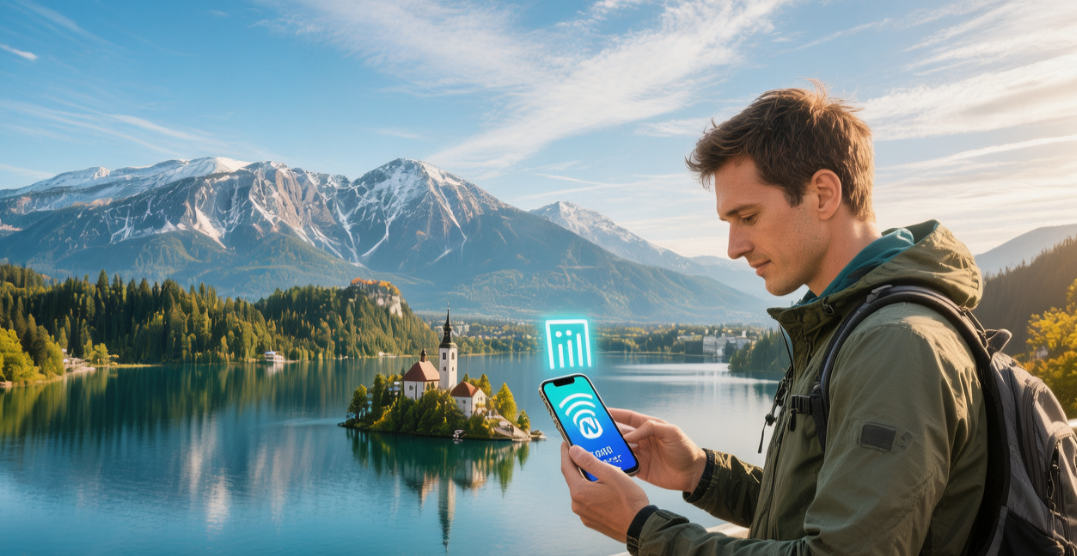
US- and UK-market phones generally work in Slovenia. Roaming typically costs about $10/day or $2–5/MB, while an eSIM is usually around $12–20 for 10GB, saving roughly 70%.
Will My Phone Actually Work in Slovenia
Hardware Band Compatibility
Mobile coverage in Slovenia works a lot like radio broadcasting: your phone has to tune in to the right frequencies to pick up the signal. The country’s three main carriers—Telekom Slovenije, A1, and Telemach—all use standard European network bands. If your phone is going to get online, it has to support those frequencies.
In most cities, 4G runs mainly on Bande 3 (1800 MHz). That band carries roughly 70% of mobile data traffic in central Ljubljana. Around the Triple Bridge near the train station, where foot traffic is especially heavy, towers also switch on Band 7 (2600MHz) to ease congestion and keep pages from hanging while they load.
Out in remote suburbs or the mountains, the rules change. High-frequency signals do not travel far, so everything depends on the lower-frequency Band 20 (800MHz). Its long wavelength can pass through thick farmhouse brick walls and bring a weak 4G signal into villages on the edge of Triglav National Park.
Budget contract phones sold by smaller US carriers often run into trouble here. Before 2019, some low-cost Android phones sold by Boost Mobile cut the Band 20 antenna to save money. Take one of those stripped-down models to the outskirts of Lake Bled, and the signal can drop straight to 3G; uploading a 2MB landscape photo may leave you standing in the cold for more than ten seconds.
A phone bought in the UK feels right at home in Slovenia. Devices sold through UK O2 stores use the exact same 4G frequencies as Slovenia. Land at Jože Pučnik Airport with a phone bought in London, power it on, and it can match to a Telekom Slovenije tower almost immediately.
When you check your phone’s specs, look for these key numbers:
- The 4G list includes B3, B7, and B20
- The 3G network includes 900 and 2100MHz
- 5G shows n28 or n78
- The phone was released in 2020 or later
Modern smartphone chips support a huge range of frequencies. The US version of the iPhone 13 is slightly different from the European model, but Apple still includes the hardware needed for Europe’s main bands. After you clear immigration and take out your phone, it will usually connect to a local network within five or six seconds.
The US version of the Samsung Galaxy S22 uses a Qualcomm modem that can recognize radio bands from more than 30 countries. In speed tests on the streets of Maribor, Slovenia’s second-largest city, it can combine signals from two bands at once and pull down around 15MB of data per second.
Slovenia began rolling out 5G in 2021, mainly on n28 (700 MHz) and n78 (3500MHz). n28 is used for broad coverage along the coast, while n78 delivers ultra-fast speeds in crowded urban areas. At the port of Koper, a European Pixel 7 Pro can reach as high as 400Mbps in a speed test.
In the US, 5G largely took a very high-frequency path, centered on 28GHz and 39GHz. The US iPhone 14 even has a small oval cutout on the side for a dedicated antenna that receives those bands. Slovenia has no such ultra-high-frequency base stations, so that custom antenna on a US iPhone does absolutely nothing on the streets of Ljubljana.
Different phone brands behave very differently when hunting for towers:
- Google Pixel tends to cling to 800MHz to maintain full bars
- OnePlus tends to chase higher-frequency signals for faster loading speeds
- US Motorola models often need a few manual tweaks to the roaming switch in Settings
- European Sony phones switch between towers extremely quickly
Slovenia’s 3G network is already in its final phase. The three major carriers are clearing out the old 900MHz spectrum once used for 3G and reusing it for more advanced 4G equipment. Take an old iPhone 4s to a small town like Pivka, and it may not even load a basic restaurant webpage; the top of the screen will simply show no service.
The underlying technology for phone calls has already changed completely. Voice now travels as data packets over 4G. If you roam in Slovenia with a US T-Mobile SIM and accidentally turn off the “VoLTE Calls” setting, dialing local emergency number 112 may produce a silent lag of 3 to 5 seconds.
Low-end Samsung variants sold by AT&T in the US often lack the hardware needed to receive 800MHz signals. On a coach ride through the rural roads outside Celje Castle, where the countryside relies entirely on low-band 800MHz towers, your companion may still be sending photos while the signal bars on your phone have already dropped to zero.
New flagship phones are getting much better at finding usable signals. The iPhone 15 Pro has an AI-driven system that actively manages its antennas. High in the Julian Alps at elevations above 2,800 meters, it keeps scanning the airwaves from 700MHz to 2600MHz and can still latch onto a weak signal long enough to send a few WhatsApp messages.
Older infrastructure is disappearing faster than most people expect. Over the past three years, Slovenia has dismantled more than 400 towers that once served 2G phones. A classic Nokia bar phone that relies on 900MHz for calls is basically a brick at the Kranjska Gora ski area now. Fully digital 4G channels have taken over nearly all the radio resources.
Before boarding, do a few basic physical checks on your phone:
- Use a pin to open the SIM tray and wipe any fine dust off the copper contacts with a tissue
- Update iOS or Android to the latest version
- Make sure the Data Roaming toggle in Settings is turned on
Carrier Lock Status
Your plane lands at Ljubljana Jože Pučnik Airport. You buy a Telekom Slovenije SIM in the terminal shop for €15, with 50GB of data included. You use a pin to open the tray, slide the new SIM in, and instead of full signal bars in the top-left corner, you get a cold message on the screen: “Invalid SIM.”
There is nothing wrong with the phone’s hardware. It can absolutely receive local 1800MHz signals. The problem is a software restriction imposed by your home carrier. The store that sold you the phone placed a digital lock in the background, so the device will only accept its own network.
Travelers coming from the UK almost never run into this anymore. UK telecom regulators introduced a hard rule banning EE, Vodafone, O2, and others from selling locked devices after December 2021. If you bought your phone in London anytime in the last three years, you can usually insert a local SIM on arrival and start streaming immediately.
Travelers still using older UK phones need to be more careful. If you got an iPhone 12 in 2020 on a 24-month contract, there is a good chance the device still carries a network restriction. Call the carrier’s free support line before heading to the airport, provide the 15-digit IMEI, and they can usually remove the lock within three business days.
The rules for US contract phones are much more complicated. If you picked up a new phone from an AT&T store on a 36-month installment plan, it stays tied to AT&T until the balance is paid off. Buying a cheap local data package in Slovenia will not help; inserting the SIM will only trigger a network error.
T-Mobile works differently. A newly purchased phone has to stay active on its network for 40 consecutive days. Fly to Europe with a phone you bought only two weeks ago, scan a discounted Slovenian eSIM QR code, and the screen will show nothing but a red exclamation mark.
US carrier policies are complicated, so keep these deadlines in mind:
- Verizon automatically unlocks a new phone 60 days after activation
- AT&T requires the phone to be fully paid off and the unlock request submitted online
- Boost Mobile requires 12 continuous months of paid service
- T-Mobile prepaid service requires a full 365 days of real usage
Verizon users actually get a fairly decent deal. In 2019, the FCC stepped in, and since then Verizon has had to unlock new phones automatically after 60 days. Bring a device you have used for two months on a hike up Mount Triglav, and it should work with just about any local SIM you buy.
Checking whether an iPhone is locked is very simple. Open Settings, go to General, then About, and scroll down to the Carrier Lock section. If you see Aucune restriction SIM, you can board your flight with peace of mind. If not, contact the seller before you leave.
On Android, the menu is buried a little deeper. On a Samsung Galaxy S23, for example, go to Settings, then Connections, then Mobile networks, and look for “Network operators.” If you can manually search and see a long list of unfamiliar networks, the phone is unlocked. If the menu is grayed out and cannot be tapped, the device is still locked.
Trying to force-install a digital data plan on a locked phone leads to all kinds of trouble. Say you spend $8 on Airalo for a 7-day 3GB Slovenia package. The moment the iPhone scans the code, it throws up a warning that says “Unable to Add Cellular Plan.” You do not get your money back, and you still do not get service.
Three days before departure is about as late as you want to leave it. If you confirm the phone is locked, call customer service right away. Give them your four-digit account PIN and your device ID. If you get a capable agent, they may be able to push the unlock command to the motherboard in as little as 10 minutes.
Unlock requests get denied every day. The most common reason is an unpaid installment balance. Bring that phone to Slovenia and it turns into nothing more than a brick that can connect only to hotel Wi-Fi. In central Ljubljana, you might occasionally catch free public internet under the trees in the square, but walk one block and you are offline again.
Before you leave, do a few extremely simple checks yourself:
- Borrow a SIM from a different carrier and test whether the phone can place a call
- Log into your carrier account and make sure there are no unpaid installment charges
- Search your email for any official unlock confirmation messages
- Use a magnifying glass if necessary and read the fine print at the bottom of your purchase contract
Roaming Costs
🇺🇸 US Carriers
Land at Ljubljana airport with an AT&T phone, connect to a local network, and a text message will arrive right away. Your bill instantly goes up by $12. That fee buys you the next 24 hours of normal usage—data, calls, and texts—just like you were back in the US.
Once AT&T has charged you for 10 days, it stops charging roaming fees for the rest of that billing cycle. That puts the monthly roaming cap at $120. If the whole family is traveling together, only the first line pays full price; the daily fee for additional lines is cut in half to $6 each.
Verizon works a little differently: it charges a flat $10 per day. The clock resets at midnight local Slovenia time. That daily fee gets you 2GB of high-speed 5G or 4G data.
Once you go over 2GB, the speed gets throttled all the way down to 3G levels. Try sending a 15-second HD video from the seafront in Piran, and it might take hours to upload. If you upgrade before leaving to the $100 monthly plan, though, you get 10GB of data to use in Europe included.
T-Mobile’s premium plan users get a better deal. A plan like Go5G Plus includes 5GB of high-speed roaming data at no extra charge. If you are hiking in Triglav National Park and keeping GPS tracking on the whole time, that 5GB is usually enough for about three or four days.
Once the free data is gone, speeds drop to a frustratingly slow 256kbps. At that speed, checking a restaurant review with photos on Yelp can mean waiting more than ten seconds for a single image to load. If you cannot tolerate that, you have to pay for a data pass.
| Carrier Pass | Prix | High-Speed Data Included | Validité |
|---|---|---|---|
| T-Mobile 1-Day Pass | $5 | 512MB | 24 heures |
| T-Mobile 10-Day Pass | $35 | 5 Go | 10 jours |
| T-Mobile 30-Day Pass | $50 | 15 Go | 30 jours |
| Mint Mobile 1-Day Pass | $10 | 1 Go | 24 heures |
| Mint Mobile 7-Day Pass | $20 | 3 Go | 7 jours |
Budget prepaid carriers like Mint Mobile now mostly sell add-on packages like the ones above. Pay $20 for a 7-day pass and you get just 3GB total. Around Lake Bled, that is barely enough if you are careful—checking maps now and then and maybe ordering an Uber.
Use Xfinity Mobile in Slovenia and you will also pay $10 a day. The catch is that you only get 512MB of high-speed data per day. Once that is gone, you drop to 2G, and even plain text webpages start to crawl.
Google Fi is the exception. There is no daily charge at all. As long as you are on the $65 monthly plan, you can land and use your phone without changing anything. The 50GB of high-speed data on your plan works in Slovenia exactly the same way it does at home.
The SIM will automatically connect to whichever local network is strongest. But if you keep using it abroad for 90 consecutive days, Google’s system may suspend your international data service. You then have to return to the US and reconnect to a domestic network before overseas data access is restored.
If you buy no roaming package at all, pay-per-use charges can be brutal. With AT&T, for example, 1MB costs $2.05. Most people are so afraid of accidental charges that they simply turn off mobile data entirely and rely only on free Wi-Fi in hotels and cafes.
Forget to disable data and leave the phone off Wi-Fi for a moment, and three emails with large attachments can download in the background without you noticing. Just 50MB of data can disappear in an instant. That is enough to add well over $100 to your monthly bill.
Bank verification texts are another trap a lot of people miss. The moment your phone has signal in Slovenia and receives a text, AT&T or Verizon may trigger that $10 or $12 daily roaming charge immediately.
Wi-Fi Calling can save you a lot of money. Connect to a decent network in your Ljubljana hotel, and once the Wi-Fi Calling indicator appears on screen, calls back to the US are treated like domestic calls rather than international roaming. That means you avoid the $3-per-minute international charge. But step outside, lose Wi-Fi, and answer even a 10-second spam call, and the roaming call charges can appear on your bill by the minute.
If you want to avoid roaming charges completely, do the following before boarding:
- Open your carrier app, go to account settings, and turn on the option to block international data
- On iPhone, go to Settings > Cellular, tap your primary line, and turn off Data Roaming
- Scroll down and turn off Wi-Fi Assist, so the phone does not quietly switch to mobile data when Wi-Fi is weak
- The safest option of all is simply to remove the US SIM—if it cannot receive even a single text, it cannot trigger any charges
Since Brexit, using a UK SIM in Slovenia is no longer automatically free. Before you board at Heathrow, you need to know exactly how much your carrier will charge per day. Of the UK’s four major legacy networks, three have brought EU roaming charges back.
If you use EE in Slovenia, you will be charged £2.47 per day. The moment you land in Ljubljana Old Town that morning and connect, the charge is taken. Stay for ten days, and you will spend around £25 just on roaming. If you travel often, it is cheaper to buy a £25 monthly Roam Abroad Pass in advance.
Vodafone adds £2.42 per day to your bill. For longer trips, it sells two roaming passes: £12 for 8 days, or £17 for 15 days, which works out a little cheaper overall.
Three users with Go Roam enabled pay a flat £2 per day. But even with a daily roaming add-on, you still cannot use data without limits. These carriers all enforce what they call a fair usage cap in the background.
Vodafone caps usage in Europe at 25GB per month. Upload a high-definition video by Lake Bled, and once you go past that 25GB limit, each additional 1GB costs a painful £3.13.
Three is even stingier, allowing only 12GB per month abroad. Anything above that is billed at 0.3p per MB. Make a one-hour video call home from the foot of Mount Triglav and use 1GB of data, and your bill goes up by about £3.
EE is more generous with a 50GB cap. As long as you are not sitting in a hotel using mobile data to download dozens of gigabytes of HD TV shows, 50GB is more than enough for a two-week holiday in Slovenia spent checking directions and scrolling TikTok.
Of the four major UK networks, only O2 still broadly holds the line against standard EU roaming fees. Take an O2 SIM to Slovenia and you do not pay the extra daily £2 or £3 charge at all. It does, however, cap usage at 25GB, and anything above that costs a steep £3.50 per GB.
A huge number of UK users have switched to cheaper sub-brands that run on the major networks. Their pricing in Slovenia varies widely.
| Budget SIM Brand | Daily Charge in Slovenia | Free Data Allowance | Que se passe-t-il ensuite ? |
|---|---|---|---|
| Giffgaff | No charge | Up to 5GB | 10p/Mo |
| Smarty | No charge | Up to 12GB | Service stops or you buy an add-on |
| Lebara | No charge | Up to 30GB | Charged at the standard base rate |
| Tesco Mobile | No charge through 2025 | Your normal plan allowance | Charged according to your usual overage terms |
| Voxi | Europe Pass required | 20 Go | Service is cut off and you must buy again |
Use a Giffgaff SIM on the streets of Maribor to check how to get around, and there is no £2 daily fee. But that 5GB disappears quickly if you browse images. Once you go past 5GB, every 1MB costs 10p. Watch a single 100MB short video and a £10 balance is gone.
With Voxi, you must buy a Europe Pass. A 1-day pass costs £2.20, while a 15-day pass costs £12. Over those 15 days, you can use up to 20GB total. If you forget to buy the pass online in advance, you may not be able to get onto a Slovenian mobile network at all.
Tesco Mobile is very generous to ordinary travelers. It has publicly said that its original free EU roaming policy will remain in place through the end of 2025. So if you pay for a 100GB monthly plan in the UK, you can use that full 100GB in Slovenia too.
Lebara includes up to 30GB of free EU data. Spend half a day at Postojna Cave sending your location and uploading photos, and you will probably use no more than 200MB. Thirty gigabytes is easily enough for a multi-country European group tour lasting a couple of weeks.
Many people travel slowly from London to Slovenia by train, passing through France, Germany, and Austria on the way. If you forget to turn off mobile data, every time the phone crosses a border and latches onto a new country’s network, carriers like EE or Vodafone may trigger another day’s roaming fee.
Stay in Gorizia on the Slovenia–Italy border, and you may find yourself physically standing in Slovenia while your phone drifts onto an Italian tower. Both countries are in the EU zone, but the constant switching can trigger fraud-warning texts on some SIMs.
If you are using an ordinary pay-as-you-go SIM without a roaming package, calling the UK from Slovenia at standard rates gets expensive quickly. Voice calls usually cost 10 to 20p per minute, and a plain text message costs 5 to 6p.
If someone calls you while you are eating in a restaurant in Piran, and you have already paid for a daily roaming plan, receiving the call costs nothing. But if you are using an ordinary SIM without the daily pass, even answering a call may deduct a penny or two per minute from your balance.
Before you leave, always log into your carrier’s website and check whether international roaming is actually enabled on your account. If you land in Slovenia and discover you have no signal, you may not even be able to receive the verification code needed to sign in and top up.
If you do not want to pay a single penny in roaming charges, change these settings before boarding in London:
- In your phone’s mobile network settings, manually disable the UK SIM you do not plan to use
- Download the full Slovenia map pack in Google Maps in advance—it takes about 250MB of storage
- Set photo backup to “Wi-Fi only” so apps cannot quietly burn through data
- Wait until you are back at your Airbnb and on Wi-Fi before sending photos to friends
Pay-Per-Use Billing
If you do not buy a $10 or $12 daily roaming pass and you switch on mobile data in central Ljubljana, billing starts immediately by usage. With carriers like AT&T or Verizon, the default rate without a roaming package is $2.05 per megabyte (MB). It sounds small—just a couple of dollars—but most people are used to monthly plans with tens of gigabytes and never stop to think about how tiny 1MB really is.
In reality, 1MB is almost nothing—not even enough to download a completely ordinary MP3. Say a friend sends you a photo of grilled fish by the sea in Piran on WhatsApp. Your phone quietly downloads that compressed image in the background, and just like that, 2MB is gone. One glance at someone else’s lunch photo can add $4.10 to your bill.
“I had just gotten off the bus at Lake Bled and stood by the roadside for less than five minutes. I never even took my phone out of my pocket, but a few work group messages came through, and that night I found I was already more than $80 in the hole.”
It is not just the webpages you open yourself. Background data is a bottomless pit. Your weather app refreshes temperature and rain probability every half hour. Your work email quietly pulls down three messages with high-resolution PDF contracts attached. Those two things alone can burn 30MB to 50MB in a matter of seconds.
At $2.05 per MB, 50MB means more than $100. You may never even light up the screen, yet you have effectively handed over the cost of a nice dinner for two at a local restaurant. And if you feel like posting on social media, uploading a 10-second 1080p HD video is usually about 20MB.
By the time the upload spinner finishes its little circle, you have been charged about $41. Calls are no less painful. A T-Mobile user without a roaming package pays $0.25 per minute for calls in Slovenia. Verizon is worse: international voice calls can cost as much as $1.79 per minute.
Someone calls you, you assume it is spam and ignore it, and they leave a 30-second voicemail instead. That audio message gets pushed to your phone through the local network, and Verizon may still bill you as if it were a full minute of international calling. A plain text message can cost $0.50 to send, and some older plans even charge $0.05 just to receive one.
For UK users traveling in Europe without a package, standard-rate charging is just as painful. Since Brexit, some prepaid UK SIMs without an active domestic plan charge 10p per MB while roaming. Use 500MB on the streets of Maribor and you can easily burn through about £50.
“My old UK prepaid SIM searched for a network at the border just long enough for me to call the host and confirm the entry code to the apartment. The call lasted barely two minutes, and my £5 balance vanished instantly. The line was cut off on the spot.”
Many people leave automatic app updates turned on by default in their app store settings. You might be walking through Triglav National Park in the morning while your phone quietly updates a ride-hailing app in the background—150MB gone. That single app update alone can create a $300 bill if charged at US pay-per-use rates.
European telecom law does include one protective measure: once a UK user’s roaming charges in Europe hit £45, the carrier must cut off data access automatically. To continue, you have to confirm by text that you are willing to keep paying. US carriers have similar blocking systems.
Most US carriers will send you a warning text and suspend data once you have burned through about $100 in overseas pay-per-use charges. By the time you see that warning, though, the $100 is already real and will appear on next month’s bill in full.
Before you leave, double-check the biggest data drains on your phone:
- Podcast apps that automatically download the latest episode—a one-hour talk show can be close to 80MB
- Cloud storage apps with background sync—five or six full-resolution landscape photos can upload tens of megabytes in seconds
- Video autoplay in social apps—scroll a few times and several clips buffer in advance, using far more data than most people realize
If you are driving around Slovenia in a rental car, opening Google Maps and starting navigation can use 10MB to 15MB just to load the first five minutes of route data. Miss a turn and force the app to recalculate, and there goes a few more megabytes.
When you are driving, you are not constantly watching your remaining data. After a 90-minute drive to the public parking lot at Postojna Cave, your navigation app may have quietly used 35MB. At pay-per-use rates, that works out to more than $70—far more than the cost of renting a Volkswagen Golf for the day.
“Do not kid yourself with the idea that you will just go online for a second to check the route and then turn it back off. The moment your phone connects, the backlog of notifications and app data it has been holding for hours hits all at once like a tidal wave.”
Some people do not remember to swap SIMs until after landing. In the brief few seconds when they turn off airplane mode and fumble to insert the local SIM, the original SIM reconnects to the local network and hundreds of group messages flood in.
Animated high-resolution stickers sent by friends start moving inside the chat window, each one several megabytes in size. By the time you pull the old SIM out, the phone may already have burned through more than 10MB in the background. In just those few seconds, the bill has quietly recorded another $20 or $30 in charges.
Cheap eSIMs
RedEx
Your easyJet flight from London Gatwick lands in Ljubljana. The whole trip is only 72 hours, so wasting half an hour hunting for a physical SIM shop in town makes no sense. Before boarding, while still at home on Wi-Fi, download the 149MB RedEx app. The moment you turn off airplane mode after landing, you can already receive WhatsApp messages from friends.
The app sells fully digital eSIMs. There is no long real-name registration form, and no need to hold your passport up to the camera for verification. Add Apple Pay or a credit card with a Visa logo, spend $4.50 on a basic 1GB package, and within two seconds of paying, an installation prompt appears on screen.
How much data you should buy depends entirely on how long you are staying:
| Data Pack | Validité | Price (USD) | Idéal pour |
|---|---|---|---|
| 1 Go | 7 jours | 4.50 | Weekend trips and airport transfers |
| 3 GB | 15 jours | 8.00 | Casual travel of about a week |
| 5 GB | 30 jours | 13.00 | Road trips across several cities |
| 10 GB | 30 jours | 22.00 | People who need hotspot data for work every day |
RedEx does not operate its own towers in Slovenia. In practice, it leases network access from A1 or Telekom. If you wander into an old lane where the signal weakens, your phone quietly switches to the stronger network within about 15 seconds. The handover is so smooth that Google Maps keeps running without freezing, even while driving.
Buy the $8 3GB package, and over seven days it goes surprisingly far:
- About 14 hours of Google Maps 3D street view
- Translating the Slovenian menus at 20 different street-side restaurants with a camera app
- Sending 1,200 full-resolution photos back home to family chat groups
- Watching two 20-minute short-video sessions every day, morning and evening
Take the 70-meter glass funicular up to Ljubljana Castle. As the car climbs, glance at your phone and the signal stays steady at four bars. Run a speed test and downloads sit around 45Mbps. Stand on the highest observation terrace of the castle and make a video call back to the UK—the red rooftops behind you come through sharply, and the audio does not smear or lag.
Drive 55 kilometers northwest from the city to Lake Bled. On the motorway near the lake, the app quietly shifts your connection to Telekom, which has the strongest tower coverage in the area. Renting a small wooden boat out to the island usually takes about half an hour. Sitting there on the rocking water, you can upload a 30-second Instagram story in about 12 seconds.
Come in on a green FlixBus from Venice, Italy. The moment the wheels cross the border at Gorizia, the old TIM Italy signal drops out. Open the RedEx app, switch the Slovenia package toggle to green, and after about 40 seconds the letters LTE appear in the top-right corner.
Because it is a data-only plan, you do not get a local +386 number. On a Friday night, if you want to book a table at a Michelin-recommended restaurant in the city center, the regular phone dialer will not get you through to the landline. WhatsApp calling works, or you can ask the hotel front desk to call for you. Uber-style ride apps still work normally over data.
If you are worried about arriving abroad with no connection, do these things before you leave home:
- Update your phone to the latest major iOS or Android version
- Download the 5MB configuration profile over your home broadband
- Buy the package in the app ahead of time, but do not activate it yet
- Make sure the eSIM switch stays hors until after the plane lands
Hotel Wi-Fi typically tests around 150Mbps. Before going to sleep, set the eSIM’s cellular line to Mode de données faibles. Otherwise your phone may quietly use mobile data overnight to upload the 2GB of photos you took that day to iCloud. Leave it alone, and that $4.50 package could be completely burned up by morning.
If you are unsure how much data you have left, open the app and check the dashboard on the main screen. A pie chart shows exactly how much has been used. Once you hit 80%, a warning pops up in the center of the screen. Need more? Buy the 5GB package for $13 and pay with two taps of the side button—no need to scan another code.
If your phone refuses to get online, tap the little live-chat icon in the lower-right corner of the app. Send a few lines in English at 11 p.m. and wait about five minutes in the queue. The support agent can check the access logs in the background and may tell you to change the APN to globaldata in your settings. Restart the phone, and two minutes later webpages open normally again.
Your short trip ends, and you pack up for the train to Croatia. Any unused data expires automatically on schedule in the background. Once you are home, there is no need to hunt for a SIM pin and poke open the tray; your wallet is also spared one more plastic SIM card destined for the trash.
Telekom Slovenije
Speeds in central Ljubljana can be misleading. Drive 55 kilometers northwest to Lake Bled, and signal bars can drop very quickly. Free 2G roaming from US T-Mobile is limited to 128kbps. Loading a single 2MB topographic map on your phone can take nearly two minutes. Go hiking deeper into Triglav National Park, and US or UK roaming SIMs may lose service entirely.
Slovenia covers 20,273 square kilometers and has more than 1,500 base stations nationwide. Even hiking routes near the 2,864-meter summit of Mount Triglav have LTE coverage. On the mountain roads starting from Kranjska Gora, you can spot towers disguised as trees every two kilometers or so.
Coverage in remote areas is surprisingly specific:
- Three 5G small cells are installed east of the main Julian Alps summit area
- Measured speeds of 85Mbps in the sunken ticket plaza at Postojna Cave
- Full signal within two nautical miles off the old town of Piran
- VoLTE calling works throughout the Kranjska Gora ski area
- Continuous 4G coverage has been deployed along the Soča Valley rafting route
In the arrivals hall at Ljubljana Jože Pučnik Airport, there is a red-and-white self-service kiosk on the right. The screen offers six European languages. Scan your passport on the reader, pay €9.99 by card, and the machine prints a 10-centimeter receipt with a 16-character Mobi package activation code.
On an iPhone 14 Pro, go to Settings and open Cellular. Point the camera at the black-and-white QR code, and a blue progress bar appears. It uses about 3.5MB of the airport’s free Wi-Fi, waits 45 seconds, and then the signal bars refill in the top-right corner while the carrier label changes to Telekom SI. A welcome text with a support link arrives in your inbox.
At two in the afternoon, sitting on the grass in Tivoli Park, Speedtest by Ookla shows a ping of 12ms. Download speed reaches 215Mbps and upload hits 42Mbps. Uploading a 450MB travel video to iCloud takes two minutes and fifteen seconds. Nearby, a tourist sipping coffee sends ten 12-megapixel photos in just four seconds.
A UK O2 number uses the roaming network here. At eight in the evening near the Triple Bridge, speeds slow down when the area gets crowded. Native Telekom numbers, however, have top-priority QoS 9 resource allocation, and webpages open instantly 98% of the time. Even in the packed Central Market, payment confirmation appears immediately when you scan to pay for snacks.
Ten gigabytes is enough to cover an entire trip:
- 65 hours of Spotify streaming at maximum quality
- 18 hours of FaceTime video calls
- 12 hours of TikTok scrolling
- 5,000 emails with high-resolution attachments
- 25 full days of Google Maps navigation
The 30-day validity is more than enough for most trips. If you decide to stay longer, open the English version of the Moj Telekom app on your phone. Link a Visa card issued by Chase in the US, spend €5 on a 5GB top-up, and within three seconds a confirmation text appears. There is no need to queue at a corner newsstand to buy and scratch off a recharge voucher.
If your service drops out, call 080 8000 and press 2 for English support. Call at 3 p.m. on a Tuesday and you may wait only 45 seconds. The support staff can see the base stations within 50 meters of your location in their system. Follow their voice instructions to adjust your APN settings, spend three and a half minutes making the change, hang up, and your data starts working again immediately.
Back at the hotel, the lobby Wi-Fi might only manage 2Mbps. Turn on your phone’s point chaud personnel and share it with your MacBook. The package does not throttle hotspot speed, so you can connect two laptops and an iPad, pull down email, and burn through 800MB in an hour of serious work. Even a 30-minute Zoom call across countries stays sharp the whole time.
Carrier shops in town close promptly at 5 p.m. Finding a convenience store that sells physical SIMs on the weekend can mean a 15-minute walk. If your flight from Los Angeles via Munich is delayed by five hours and you land at 11:30 p.m., everything will be dark and shut. But with Wi-Fi, you can scan the code, get online instantly, and call an Uber into the city.
A1 Slovenija
At 7:30 in the morning, Ljubljana railway station is packed with young travelers carrying oversized backpacks. An international train from Vienna pulls into platform 3. The advertising boards across the platform are dominated by A1’s red-and-white branding. Pay €9.99 for a prepaid package, and your phone gets a full 100GB of usable data.
AT&T charges $10 a day for roaming, and once you pass 2GB it slows you to 2G. UK EE charges £2.29 a day for Europe roaming, and after just a few videos you start getting warning texts about limits. With 100GB in hand, you can live comfortably in Slovenia for 30 days without constantly hunting for free café Wi-Fi.
Download the English A1 app, tap the shopping cart icon in the top-right corner, and enter the details of a Mastercard with a chip. Three seconds later, an activation email with a QR code arrives right on schedule. Open Settings on your iPhone 13, scan it once, and in less than five seconds the 5G icon appears in the top-right corner. The whole signup process requires no passport registration.
Walk along the Ljubljanica River through the city center and you will spot gray antennas on rooftops every couple hundred meters. Reach bustling Prešeren Square, where thousands of tourists are all taking photos and posting them to Instagram at once, and Speedtest still shows a steady 310Mbps down and 65Mbps up.
That 100GB allowance stands up to serious use:
- 45 hours of Full HD Netflix streaming without buffering
- 20 full days of nonstop Zoom meetings
- Using it as a router for two laptops playing online games
- Uploading 20,000 RAW photos from a DSLR
- 200 hours of high-quality podcast playback
Rent a car and drive the A1 motorway from the capital to Maribor, about 130 kilometers in total. Stream lossless Spotify over Bluetooth through the car’s audio system. At 130 km/h, the traffic overlay in your navigation app stays solid green the whole way. Even through three tunnels more than two kilometers long, the music does not drop for a single second.
Once you reach Maribor, Slovenia’s second-largest city, the cobbled old town is lined with cafés. Sit beneath an umbrella outside and make a video call to a friend in Boston. Every strand of their hair is visible on screen, and latency stays tightly under 20ms in both directions.
In cities, A1 mainly runs on the high-frequency 1800MHz and 2600MHz bands. A US Samsung Galaxy S22 brought over from New York matches those frequencies perfectly. A Google Pixel 7 bought in the UK can detect the towers and connect the moment it powers on.
The app’s main screen features a large data meter right in the center. On day 15 of your trip, the needle may still show 62GB remaining. If you really do burn through the full 30-day allowance, you can add another pack for €5 in just a couple of taps on your phone. No need to wander the streets looking for a kiosk selling top-up scratch cards.
Digital nomads working across borders love the freedom that comes with a high-capacity plan:
- SSH into remote servers from a bench by the river and write code
- Edit and render a 3GB vlog in the hostel lobby
- Share a hotspot with four backpacking companions
- Download work PDFs that are tens of megabytes each whenever you need them
Drive 30 kilometers out of the city into the agricultural plains of the east, and high-frequency signals start to weaken in the open landscape. The 5G icon on screen falls back to 4G, and speed tests drop to around 45Mbps. Web browsing and photos still load easily, though 4K video may need two or three seconds of buffering now and then.
If your balance does not update properly, call 040 4040 from your phone. When the Slovenian voice prompt starts, press 9 to switch to an English-speaking agent. Call at 10 a.m. on a Thursday and the hold music may last less than 20 seconds. Once you give your number, the agent can check the payment record in about half a minute and manually restore the missing data.
At the end of a 30-day holiday, you fly out from Ljubljana airport. There is no need to visit a shop, queue up, fill out forms, or cancel anything. When the validity period ends, the network profile simply expires in the cloud. Open Settings, swipe left on the line labeled A1, and delete it in two quick motions.
 English
  French
  Spanish
  Portuguese
  Arabic
  Japanese
  Korean
  Russian
  Chinese (China)
  Chinese (Hong Kong)